

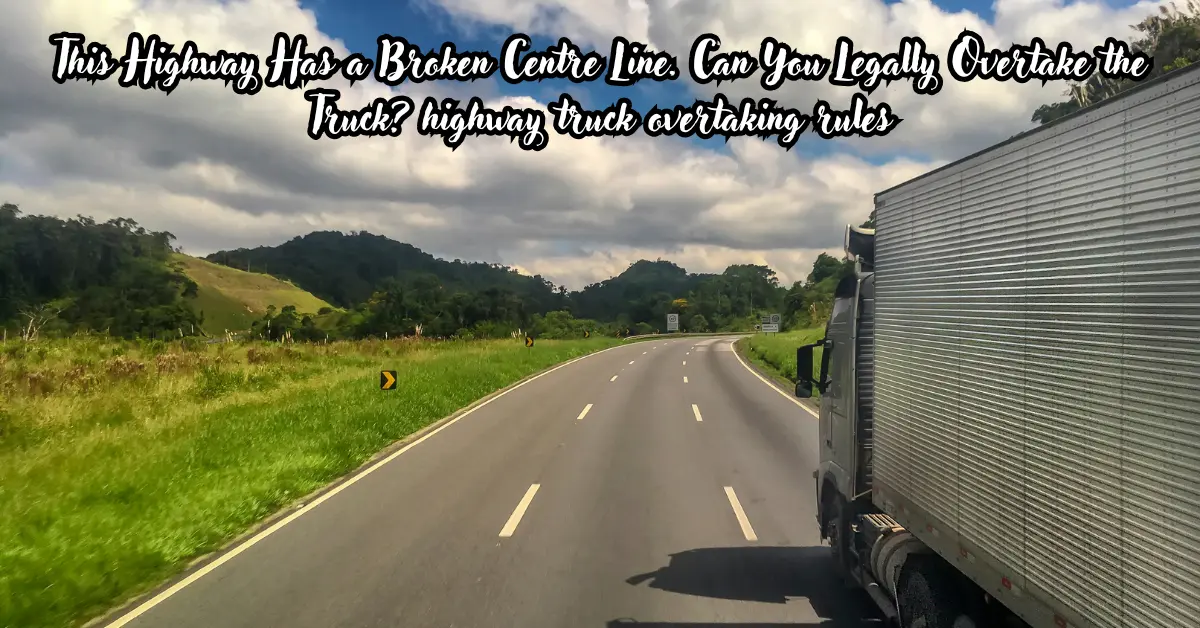
This highway has a broken centre line. Can you legally overtake the truck? In general, yes, you may be legally permitted to overtake when the centre line is broken, but only if the manoeuvre is safe and all other road rules allow it. A broken centre line is not a guarantee that overtaking is safe or automatically legal in every situation.
For drivers dealing with slow-moving trucks, this distinction is particularly important. Trucks are large, may have limited visibility around them, and can require more time and road space to pass.
Australian road rules generally allow a driver to cross a broken centre line to overtake where permitted, while continuous centre lines can restrict overtaking. Queensland Government guidance specifically states that a broken single centre line can be crossed for overtaking.
However, road markings are only one part of the decision. You still need sufficient visibility, a safe gap, appropriate road conditions, and compliance with signs and other traffic rules.
This guide explains what a broken centre line means, when overtaking a truck can be permitted, when you should not overtake, and how drivers can make safer decisions on highways.
What Does a This Highway Has a Broken Centre Line. Can You Legally Overtake the Truck? Mean?
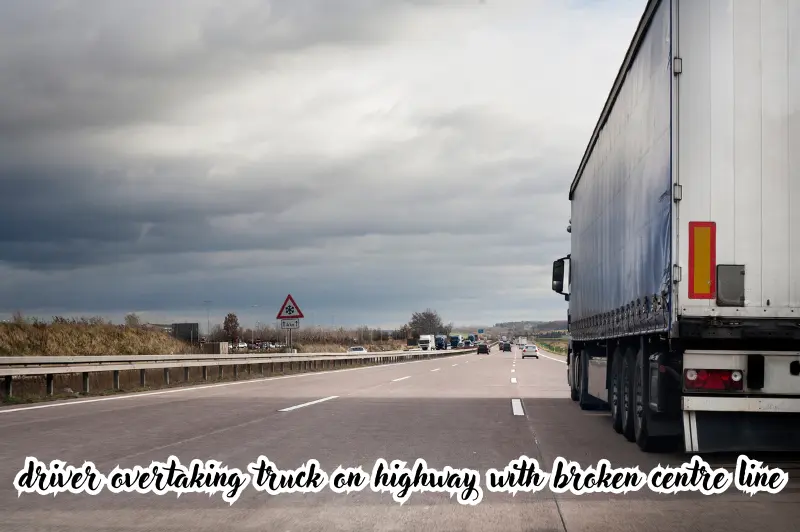
A broken centre line is a dashed road marking separating traffic travelling in opposite directions on an undivided road. Where the applicable road rules permit it, the broken marking indicates that drivers may cross the centre line for manoeuvres such as overtaking.
Queensland Government guidance confirms that a driver can cross a broken single centre line to overtake, provided the manoeuvre is otherwise permitted.
A simple way to understand it is:
Broken line = crossing may be permitted.
Solid or continuous line = additional restrictions apply.
But this does not mean:
Broken line = overtaking is always safe.
That difference is crucial.
A driver approaching a slow truck might see a broken centre line and assume the opportunity is automatically available. However, an approaching vehicle, blind corner, hill, intersection, pedestrian crossing, road narrowing, or warning sign may make overtaking unsafe or unlawful.
Can You Legally Overtake a Truck Across a This Highway Has a Broken Centre Line. Can You Legally Overtake the Truck?
Yes, if it is safe and otherwise legal
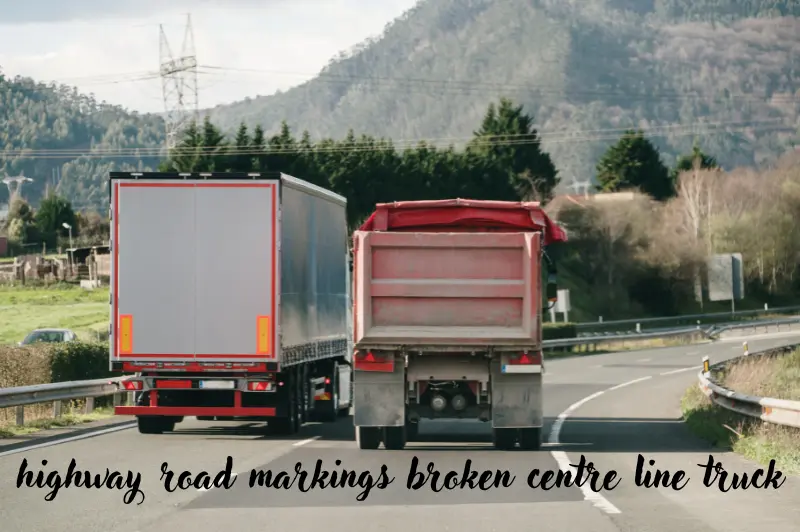
If the highway has a broken centre line and the applicable local road rules permit crossing it, you may generally overtake the truck when you can do so safely.
The key question is not simply whether the line is broken. You must also consider:
- Is the road ahead clearly visible?
- Is there enough distance to complete the manoeuvre?
- Is there oncoming traffic?
- Is the truck approaching an intersection or turn?
- Are there signs prohibiting overtaking?
- Is the road wide enough?
- Is visibility affected by a hill, curve, rain, fog, dust, or darkness?
- Can you return to your lane safely?
- Are other road users likely to change position?
- This Highway Has a Broken Centre Line. Can You Legally Overtake the Truck?
NSW Government guidance similarly stresses that drivers should have a clear view of approaching traffic and must not overtake across an unbroken dividing line. It also identifies situations such as road narrowing and certain crossings or intersections where overtaking is prohibited.
Therefore, the safest short answer to the question is:
Yes, a broken centre line can permit overtaking, but you should overtake only when you are sure the manoeuvre is safe and legal.
Why Overtaking a Truck Requires Extra Care
Overtaking a truck is different from passing a small car.
A heavy truck can be considerably longer, meaning the passing manoeuvre may take more time and distance. The truck may also obstruct your view of traffic, road conditions, signs, intersections, or hazards ahead.
Trucks can block your forward visibility
When following a large truck, you may not be able to see far enough ahead to determine whether the opposite lane is completely clear.
This creates an important rule of thumb:
Never rely on the truck driver’s position as proof that the road ahead is clear.
You need your own safe view of the road before considering a pass.
Trucks can take longer to pass
A small car may take only a short distance to pass another car. A long truck can require substantially more road space.
The longer you remain on the wrong side of the centre line, the more exposure you have to approaching traffic.
Trucks may change speed
A truck travelling uphill may slow down, while its speed can change because of traffic, road conditions, gradients, or other factors.
A driver who begins overtaking without allowing sufficient space may find the manoeuvre takes longer than expected.
When Should You Not This Highway Has a Broken Centre Line. Can You Legally Overtake the Truck?
A broken centre line does not remove your responsibility to make a safe decision.
1. You cannot see far enough ahead
Do not overtake if the road curves, rises sharply, or otherwise prevents you from seeing approaching traffic clearly. This Highway Has a Broken Centre Line. Can You Legally Overtake the Truck?
A broken line may still be present on a section of road where visibility is poor.
If you cannot confidently see enough road ahead, wait.
2. An oncoming vehicle is approaching
If another vehicle is coming toward you, do not begin an overtaking manoeuvre unless the situation clearly provides sufficient space under the applicable road rules.
Remember that the approaching vehicle may be travelling faster than it appears.
3. There is an intersection ahead
Intersections create additional risks because vehicles may turn, enter the highway, or cross traffic unexpectedly.
NSW Government guidance specifically lists situations involving intersections and other crossings among circumstances where drivers must not overtake.
4. You are approaching a crest or bend
A hill crest can hide an approaching vehicle. A bend can conceal traffic until you are already committed to the manoeuvre.
A broken line does not make a blind crest or curve a safe overtaking location.
5. A sign prohibits overtaking
Always pay attention to regulatory and warning signs.
If a sign prohibits overtaking, do not assume that the broken centre line overrides the sign.
Road markings and signs must be considered together with the applicable road rules.
6. Weather or road conditions reduce visibility
Rain, fog, dust, glare, smoke, darkness, and wet roads can significantly change the risk involved.
If conditions make it difficult to judge distance or speed, waiting behind the truck may be the safer choice.
Broken Centre Line vs Continuous This Highway Has a Broken Centre Line. Can You Legally Overtake the Truck?
Understanding the difference between road markings can make highway driving much easier.
| Centre-line marking | General meaning | Overtaking |
| Broken centre line | Crossing may be permitted where lawful and safe | May be permitted |
| Single continuous line | Crossing is restricted | Generally not permitted for overtaking where the line applies |
| Double continuous lines | Strong restriction on crossing | Do not cross for ordinary overtaking |
| Broken line beside continuous line | Depends on which side you are driving on | May be permitted from the broken-line side where rules allow |
The exact legal treatment can vary by jurisdiction, so drivers should always follow the road rules for the state or territory where they are driving.
For example, Queensland Government states that a broken centre line can be crossed for overtaking, while NSW road-marking guidance explains that a broken line on the driver’s side of certain double-line arrangements can permit overtaking.
How to Decide Whether It Is Safe to Overtake a Truck
Instead of treating the broken line as a signal to immediately pass, use a simple decision process.
Step 1: Check the road ahead
Look well beyond the truck.
You need a clear view of approaching traffic and enough road to complete the manoeuvre safely.
Step 2: Check mirrors and surrounding traffic
Before moving out, check your mirrors and blind spots.
Another vehicle may already be attempting to overtake you, or traffic behind you may affect your decision.
NSW Government advice specifically recommends checking mirrors and blind spots before overtaking.
Step 3: Check signs and markings
Confirm that there is no sign, solid centre line, road restriction, or other condition preventing the manoeuvre.
Do not look only at the line directly beneath your vehicle.
Step 4: Consider the truck
Look for indicators and changes in the truck’s position.
A truck may be preparing to turn, move around an obstruction, or change lanes.
Step 5: Consider visibility and road conditions
Ask whether you can see clearly enough to complete the manoeuvre.
If the answer is uncertain, wait.
Step 6: Make sure you can return safely
An overtaking manoeuvre is not complete merely because you have moved ahead of the truck.
You must also have enough room to return to your lane safely without forcing another road user to brake or take evasive action.
Common Mistakes Drivers Make When Passing Trucks
Mistake 1: Thinking a broken line guarantees legal overtaking
This is one of the biggest misunderstandings. This Highway Has a Broken Centre Line. Can You Legally Overtake the Truck?
A broken centre line may indicate that crossing is permitted, but other rules and safety requirements still apply.
Mistake 2: Following the truck too closely
Driving extremely close behind a truck reduces your view of the road ahead.
A safe following distance gives you more time to observe traffic and make decisions.
Mistake 3: Starting the manoeuvre too late
If you wait until you are very close to the truck before deciding to overtake, you may have less time and space available.
Good observation should happen well before the manoeuvre.
Mistake 4: Ignoring hills and curves
A broken centre line does not guarantee visibility.
A road can have a broken marking while still presenting a dangerous blind spot.
Mistake 5: Focusing only on the truck
The truck is only one part of the situation.
You must also watch oncoming traffic, intersections, signs, pedestrians, cyclists, road conditions, and other vehicles.
Mistake 6: Assuming the truck will slow down for you
Never depend on another driver to make your manoeuvre safe.
You are responsible for ensuring that your own manoeuvre is safe and lawful.
Practical Example: A Straight Highway
Imagine you are travelling behind a slow truck on a straight two-way highway.
The centre line is broken.
You can see a long distance ahead, there is no approaching traffic, no overtaking restriction applies, and there is enough space to complete the manoeuvre and return safely.
In this type of situation, overtaking may be legally permitted, subject to the road rules applicable in that jurisdiction.
The important point is that the broken line is only one part of the assessment. This Highway Has a Broken Centre Line. Can You Legally Overtake the Truck?
Practical Example: A Blind Hill
Now imagine the same truck is travelling toward a hill crest.
The centre line remains broken, but you cannot see what is coming over the hill.
In this situation, you should not treat the broken line as permission to overtake.
The problem is visibility.
NSW Government guidance states that drivers must not overtake when they do not have a clear view of approaching traffic, including before a crest or curve.
Practical Example: A Truck Near an Intersection
Suppose the truck is moving slowly and there is a broken centre line, but an intersection is approaching.
Even though the road marking might otherwise allow crossing, the intersection introduces additional risks and may trigger specific legal restrictions.
The sensible decision is to wait until the road situation allows a lawful and safe manoeuvre. This Highway Has a Broken Centre Line. Can You Legally Overtake the Truck?
Why Waiting Can Be the Better Decision
Not overtaking immediately is not a failure.
Sometimes the safest and most efficient decision is simply to remain behind the truck until a better opportunity appears.
Waiting can provide:
- Better visibility
- More road space
- Less pressure to accelerate
- More time to assess traffic
- Lower risk from unexpected vehicles
- A safer opportunity to return to your lane
- This Highway Has a Broken Centre Line. Can You Legally Overtake the Truck?
A few seconds of patience can be much better than committing to an uncertain manoeuvre.
What Indian Drivers Should Know
The exact question often appears in driving-test and road-safety contexts, but the wording about a “broken centre line” is particularly associated with Australian road-rule terminology.
If you are an Indian reader studying road rules, preparing for driving abroad, or researching highway safety, do not automatically apply Australian rules to roads in India.
Road markings, overtaking restrictions, speed limits, penalties, and signs can differ between countries and jurisdictions.
For driving in India, always follow the applicable Indian traffic laws and local road signs. For driving in Australia, check the rules for the specific state or territory.
This distinction is important for accurate GEO and local-search information because the same road marking can have different legal implications in different jurisdictions.
For more helpful information about truck safety, maintenance, and roadside services, explore our truck repair services and mobile truck mechanic guide. For authoritative road-safety and overtaking information, you can also refer to the Queensland Government road-markings guidance. These resources can help drivers better understand road markings, safe overtaking, and practical truck-related services.
Frequently Asked Questions
1. This highway has a broken centre line. Can you legally overtake the truck?
Yes, a broken centre line can permit overtaking where the applicable road rules allow it. However, you must still make sure the manoeuvre is safe, you have a clear view, there is sufficient space, and no signs or other rules prohibit overtaking. A broken line alone does not automatically make every overtaking manoeuvre legal or safe. This Highway Has a Broken Centre Line. Can You Legally Overtake the Truck?
2. Does a broken centre line mean overtaking is always allowed?
No. A broken centre line generally indicates that crossing may be permitted, but drivers must still follow other road rules and safety requirements. You should not overtake when visibility is inadequate, traffic conditions make the manoeuvre unsafe, a sign prohibits it, or another restriction applies to that section of road.
3. Why is overtaking a truck more difficult than overtaking a car?
Trucks are typically longer and can block your view of the road ahead. Passing one may therefore require more time and space. Trucks can also change speed, especially on hills. Drivers should never assume that the road ahead is clear simply because they cannot see an approaching vehicle around the truck.
4. Can I overtake a truck near a hill or bend if the centre line is broken?
A broken line does not make a blind hill or bend safe for overtaking. If you cannot clearly see approaching traffic, you should wait. NSW Government guidance specifically identifies situations with limited visibility, including before a crest or curve, as circumstances where overtaking must not be performed.
5. What is the safest approach when I am unsure about overtaking?
If you are uncertain, wait for a better opportunity. Maintain a safe following distance, keep checking the road ahead, watch for signs and changing road markings, and overtake only when you can confidently complete the manoeuvre safely and legally. Waiting for better visibility is usually preferable to making a rushed decision.
Conclusion
This highway has a broken centre line. Can you legally overtake the truck? In general, yes, overtaking may be permitted across a broken centre line when it is safe and otherwise legal. However, the broken marking should never be treated as an automatic green light.
Before overtaking a truck, check the road ahead, mirrors, blind spots, traffic, signs, road markings, visibility, intersections, curves, hills, and road conditions. Make sure you have enough space to complete the entire manoeuvre and return safely to your lane.
The most important principle is simple:
A broken centre line may permit overtaking, but safety and all other applicable road rules still come first.
For Indian readers, remember that the legal meaning of road markings depends on the country and jurisdiction. If you are driving in Australia, check the specific state or territory rules. If you are driving in India, follow Indian traffic regulations and local signage.
The practical next step is to treat the centre line as one piece of information—not the whole decision. If you cannot clearly see that an overtake can be completed safely and legally, wait for a better opportunity.
